
Listonic vs OurGroceries: Best Grocery List App for Families, Couples, and Budget Shoppers in 2026?
Which is the best grocery list app for families, couples, and budget shoppers in 2026?

This comparison is based on official product pages, user guides, App Store and Google Play listings, version histories, public reviews, and public Reddit discussions checked by July 28, 2026. Store ratings, pricing, and feature availability can vary by country or storefront view. Listonic’s retailer-offer and promotions functionality can also vary by market, so this article focuses on features that are broadly documented and publicly visible.
TL;DR
My recommendation
I recommend Listonic over OurGroceries for most people because it combines a genuinely useful AI assistant with unusually flexible free list sharing.
Choose Listonic
If you want help deciding what to buy, planning meals, building lists faster, and shopping with a partner or family with less friction — and if you want one of the strongest free tiers in this category.
Choose OurGroceries
If Alexa, recipe storage, barcode scanning, and watch support matter more to you than AI planning or easier sharing.
The biggest reason I put Listonic first is the combination of AI assistant, advanced shareable lists, shopping-history suggestions, and automatic sorting [2, 3, 4, 5, 10, 11].
There is also a difference that only shows up once something goes wrong. Across the 43,083 public app-store reviews with written comments that I went through for both apps between January 1, 2023 and July 27, 2026, Listonic replied to 92.4% of its 1–2★ reviews (3,308 of 3,579) and OurGroceries to 64.8% (169 of 261). Across all reviews the rates were 30.3% and 12.1%.
What to look for in a grocery list app in 2026
The best grocery list app in 2026 should reduce planning time, reduce in-store friction, and reduce wasted spending — not just digitize a paper list [2, 6, 10, 12].
Speed and ease of use
You should be able to build or rebuild a weekly list quickly, preferably with recurring-item memory and low setup friction.
Smart shopping assistance
The app should help you think, not just type — through AI, product suggestions, history, or strong item-capture tools.
Feature richness
A serious app should support planning, list management, store organization, notes, photos, and multi-device use without feeling cobbled together.
Budgeting
Price tracking and running totals are no longer niche features when grocery inflation is still a real household problem.
Collaboration
Real-time syncing, notifications, and flexible sharing matter a lot for couples, parents, housemates, and split-store errands.
Free-version value
Many shoppers will never pay for a grocery list app, so the free tier has to be genuinely usable.
Short introduction to Listonic and OurGroceries
Listonic and OurGroceries solve different versions of the same problem.
I see Listonic as more of a shopping-planning assistant. It helps decide what to buy, helps build lists faster, helps share lists with less friction, and helps organize the trip once you are already in the store.
I see OurGroceries as more of a stable household list utility. It is especially strong on syncing, recipes, watches, Alexa, barcodes, and long-term multi-device use.
That difference matters more than it may seem from screenshots. On a storefront page, both apps can look similar. In real use, they feel like they were built with different priorities [1, 4, 10, 11].

Listonic
A modern grocery list app built around AI planning, fast list building, low-friction sharing, and smart in-store organization
Strongest documented strengths: AI assistant, shareable lists, shopping history, smart sorting, prices, strong free tier

OurGroceries
A mature shared household list app built around recipes, barcodes, Alexa, watches, and dependable syncing
Strongest documented strengths: Alexa, Siri, Apple Watch, Wear OS, recipes, barcode scanning, export tools
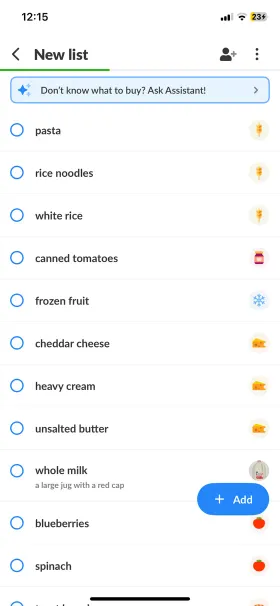
Listonic is overall better for most shoppers
My short answer is that Listonic is the better overall pick because it is stronger on AI planning, easier list sharing, smarter repeat-list building, and a broader free feature set [2, 3, 4, 5, 6, 10, 11, 12].
The core reason I put it first is simple. Listonic solves more of the real shopping workflow in one app. It helps before the trip, during the trip, and when the same household needs to repeat the process next week.
| Question | Better app | Why |
|---|---|---|
| Best overall grocery list app | Listonic | Better mix of AI help, sharing, shopping-history suggestions, and in-store organization |
| Best for families and couples | Listonic | Real-time shared lists, notifications, photos on items, low-friction sharing |
| Best for solo shoppers | Listonic | AI planning, shopping history, and smart sorting still matter without sharing |
| Best for staying on budget | Listonic | Running total, saved prices, and quantity-aware cost calculation |
| Best for Alexa-heavy households | OurGroceries | Stronger officially documented Alexa workflow |
| Best for recipe-first households | OurGroceries | More explicit recipe storage and add-to-list workflow |
| Best free-tier value | Listonic | More compelling everyday value before you ever need premium |
What Listonic’s published data adds to the case
I do not want to rest this on opinion alone, and Listonic does have first-party signals that support the recommendation [3, 5, 6, 16].
- Budgeting
-
Users who track prices can spend up to 25% less on a weekly basis
One of the clearest product-outcome signals in the comparison
- Shared shopping
-
Users who share lists report fewer forgotten items and fewer duplicate purchases
Directly matches one of the most common household grocery problems
- Faster shopping
-
Shoppers with grocery lists spend an average of 23 minutes less time in stores
Explains why better list structure has a real-world payoff
- Food waste
-
Households using shared lists reduce food waste by up to 25%
Strengthens the family-oriented recommendation
- Repetition
-
About 70% of grocery-list items are repetitive
Justifies why history-based speed features matter so much
- Support follow-through
-
Replied to 92.4% of 1–2★ reviews (3,308 of 3,579) between 2023 and 2026, against 64.8% (169 of 261) for OurGroceries
The clearest and most consistent gap in the whole review set, and it applies exactly when a shopper is stuck
- Improving, not coasting
-
Overall reply rate rose to 40.9% of reviews in 2025 (3,648 of 8,917) from 25.6% in 2023, while OurGroceries moved from 11.3% to 11.1%
Shows the responsiveness gap is widening rather than a one-off good year
- Feedback volume
-
39,231 public reviews with written comments across 73 languages since 2023, against 3,852 across 33 languages
A far larger and more linguistically diverse evidence base behind the product decisions
How I evaluated these apps
I used a weighted editorial scoring model because not all grocery-app features matter equally in real life [2, 4, 6, 7, 11, 12].
| Category | Weight | Listonic | OurGroceries |
|---|---|---|---|
| Speed & ease of use Grocery lists are repetitive. The faster the app gets you from idea to list, the more consistently you use it. | 15% | 8.8 | 7.9 |
| Smart shopping assistance In 2026, "smart" should mean real help with planning, remembering, and organizing. | 20% | 9.0 | 7.0 |
| Feature richness A better app should cover more of the real shopping workflow without forcing extra tools. | 20% | 8.7 | 8.3 |
| Budgeting options For families and frugal shoppers, budget control is not optional. | 20% | 9.6 | 4.8 |
| Collaboration options Shared shopping is one of the main reasons people choose a dedicated grocery app. | 15% | 8.7 | 8.6 |
| Free version value A lot of households want strong utility before they ever consider paying. | 10% | 8.8 | 8.5 |
| Weighted total | 100% | 9.0 | 7.3 |
| Categories won | 6 | 6 | 0 |
Keep in mind
These are my own editorial scores, based on verified feature sets, pricing structure, version history, and public user feedback. They are not lab benchmarks, but they are grounded in documented product differences.
Why you can trust this comparison
I built this article on my own research, not a skim of two Google Play profiles.
I went through official product pages, help-center documentation, App Store and Google Play listings, version history, public user reviews, and public Reddit discussions. That matters because grocery apps often look similar on a storefront page but feel very different in real life [13, 16, 17, 19, 20, 21].
I also read the reviews at scale rather than sampling them. My own analysis covers every public app-store review carrying a written comment for both apps published between January 1, 2023 and July 27, 2026 — 39,231 for Listonic across 73 languages and 3,852 for OurGroceries across 33 — which is where the reply-rate and complaint-theme figures in this article come from. Those two samples differ in size by roughly ten times, so wherever I quote a percentage from them I also give the counts behind it. They describe that comment-bearing sample rather than either app’s overall store rating.
I also did not want to flatten OurGroceries into a weak strawman. It has real strengths. I still put Listonic first because its advantages are broader for the average shopper, not because OurGroceries is bad.
What was counted
- Reviews read
- 43,083
- Listonic, across 73 languages
- 39,231
- OurGroceries, across 33 languages
- 3,852
- Reply rate on 1–2★ reviews · Listonic
- 92.4%
- Reply rate on 1–2★ reviews · OurGroceries
- 64.8%
Window: January 1, 2023 – July 27, 2026
| Source type | What it was used for |
|---|---|
| Official product pages | Core feature claims, positioning, and feature depth |
| Help centers and FAQs | Sharing setup, pricing details, export/import, edge-case behavior |
| App Store and Google Play pages | Ratings, review counts, downloads, screenshots, release notes, version history |
| Public user reviews | Real praise and complaints from active users |
| Public Reddit discussions | Independent examples of household use and where friction shows up |
At a glance
These profiles summarize the documented strengths, limitations, storefront signals, and product positioning of both apps [2, 3, 6, 7, 8, 10, 11, 12, 13, 15, 16, 17, 19].
Listonic
20M+ downloads · 350K+ reviews
Best for
- Families, couples, and shared shopping
- Solo shoppers who want faster repeat trips and better budget control
Key pros
-
AI assistant suggesting meals, seasonal picks, budget ideas, and full lists from text, voice, or photos
-
Lower sharing friction — link and WhatsApp sharing without requiring an account
-
Faster list building through shopping history, suggestions, and voice input
-
Smart sorting by aisle, category, alphabetical, or custom order
-
Strong budget tools — item prices, quantity-aware totals, saved price memory
Key cons
-
Dedicated recipe management is less explicit than in OurGroceries
-
Some public reviews mention sync hiccups or ad annoyance
-
Premium is more about removing ads than unlocking a different product
OurGroceries
Best for
- Alexa-first households and recipe organizers
- Apple Watch or Wear OS users wanting a mature shared-list utility
Key pros
-
Excellent household utility for store-specific lists, recipes, and voice-assistant workflows
-
Strong detail tools, including notes, photos, quantities, and barcode scanning against a 17M-product database
-
Broad device coverage: Alexa, Siri, Apple Watch, Wear OS, web, Mac Apple Silicon
-
Practical import and export: CSV in, XLSX or JSON out
-
Cheap ad removal, about $1/month, $6/year, or $20 lifetime
Key cons
-
No true running-total budgeting or price-memory system
-
Full household sharing requires everyone on the same account email
-
Ads can be a real friction point, including tapping an ad adding a product
-
The app still feels more utilitarian than modern
What people say about both apps
When I read through the reviews and Reddit threads, the praise clusters are very different [13, 14, 16, 18, 19].
People seem to like Listonic for family sharing, easy repeat shopping, AI help, and cleaner organization. Complaints focus on ads, occasional sync hiccups, and some resistance to interface changes. People like OurGroceries for dependable syncing, recipes, Apple Watch, Alexa, and barcode workflows — with complaints around ads, more manual workflows, and setup friction.
This app is super helpful for my family.
The new feature of AI, is convenient.
Was great, now getting sneaky with ads.
Recipe coordination is great, but could use a little tweaking.
The numbers behind those impressions
Counting themes across that whole review set rather than picking quotes tells the same story. Among negative English-language reviews — 1,222 for Listonic and 227 for OurGroceries — the shares below are the proportion of each app’s negative reviews that raised the theme. Because the OurGroceries sample is the smaller one, treat those shares as directional.
| Theme | Listonic | OurGroceries |
|---|---|---|
| Account and login trouble | 3.5% | 7.0% |
| Missing features | 2.5% | 5.3% |
| Interface and usability | 3.8% | 6.2% |
| Frustration with development pace | 6.7% | 12.3% |
Reply rates diverge most sharply exactly where a shopper is already annoyed. The gap is also widening rather than closing — Listonic’s overall reply rate improved by roughly 6.0 percentage points per year over the period, OurGroceries’ by 0.1.
| Topic | Listonic | OurGroceries | Counts |
|---|---|---|---|
| Stability and bugs | 82.1% | 51.2% | 271 of 330 vs 41 of 80 |
| Syncing | 54.3% | 10.5% | 185 of 341 vs 23 of 220 |
| Ads | 69.8% | 37.4% | 483 of 692 vs 68 of 182 |
| Subscriptions and payments | 68.9% | 20.7% | 208 of 302 vs 18 of 87 |
Why shoppers switch from OurGroceries to Listonic
The clearest reasons to switch are AI planning, easier sharing, and a more modern list-building flow.
The AI assistant
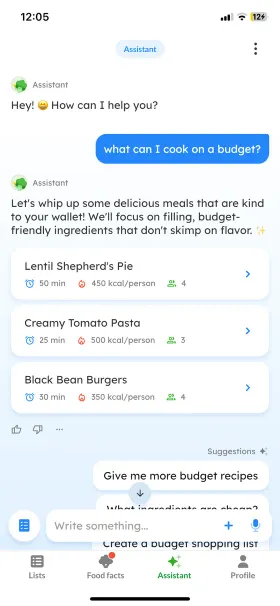
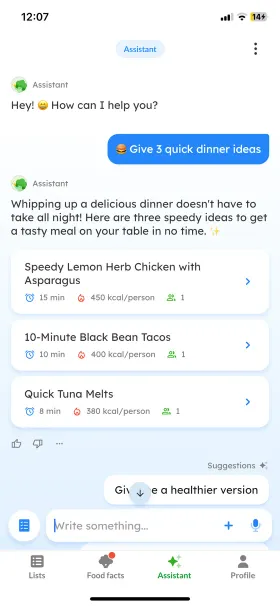
Based on Listonic’s current feature pages, it can generate a list from text, voice, or a photo, suggest meal ideas, suggest quick or cheaper recipes, suggest what is in season, and use what someone often buys as context [4].
List sharing
Listonic’s official sharing page says someone can edit a shared list without a Listonic account if the list is shared by link or WhatsApp. OurGroceries can still share well, but its full household-sharing model asks everyone to connect through the same account email. That is workable — it is just more setup [3, 11, 12].
Repeat-shopping speed
Shopping history, product suggestions, voice input, and sorting all reduce friction before the trip even starts [2, 5].
The one the review data exposes
Alexa support is one of the strongest arguments for OurGroceries, and this comparison credits it as a real advantage. Yet in the review set I went through, voice assistants and integrations were the subject of 6.6% of OurGroceries’ negative English reviews (15 of 227) and 0.2% of Listonic’s (2 of 1,222) — a feature Listonic does not compete on is one its rival’s users raise complaints about. Having the integration and having it work quietly are not the same thing.
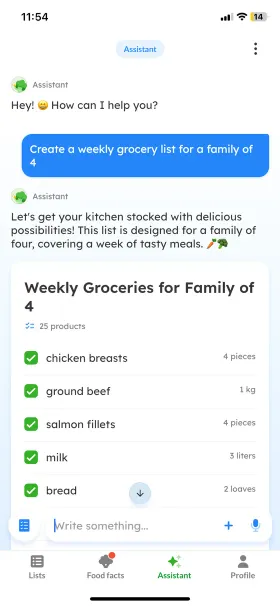
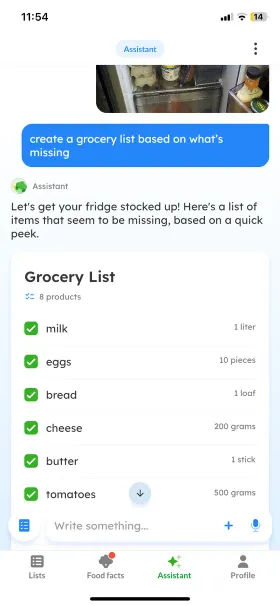
Great AI assistant: meals, budgets, and full lists from a photo
Listonic is better for AI-led shopping help because its assistant is built around planning, not just item capture.
This is where Listonic feels much more current. The assistant is not a gimmick bolted onto a checklist. It is meant to help answer the hard part of grocery shopping, which is often deciding what to cook, what you are missing, what fits the week, and what can be done more cheaply or more quickly.
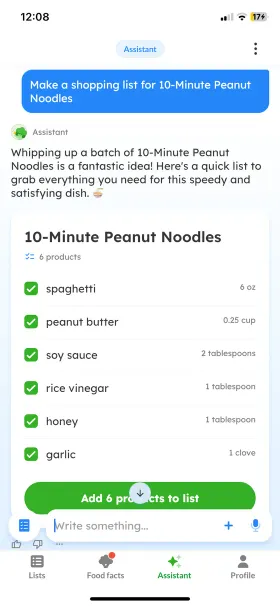
Based on Listonic’s public feature pages, the assistant can [2, 4]:
-
build lists from text, voice, or a photo
-
suggest meal ideas and recipe directions
-
suggest seasonal products
-
suggest budget-minded shopping ideas
-
use what you often buy as part of the recommendation flow
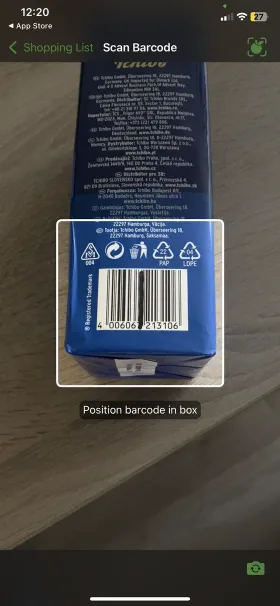
OurGroceries is smarter than it first appears, but in a different way. It is strong on photo-based item capture, barcode scanning, and utility depth. What it does not offer is a consumer-facing assistant that helps think through the whole shopping plan [11].

Speed & ease of use comparison
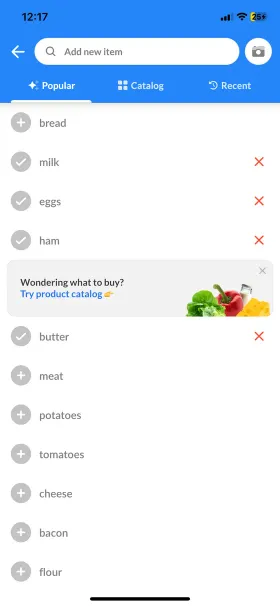
Listonic is easier for most people to start using because it removes more setup friction and puts more shortcuts in front of the user [2, 3, 11, 21].
| Task | Listonic | OurGroceries | Winner |
|---|---|---|---|
| Start a shared list with another person | Link or WhatsApp sharing with less friction | Solid household model, more setup | Listonic |
| Rebuild a weekly list | History, suggestions, AI, and saved prices | Strong repeat-item memory, less planning help | Listonic |
| Use a voice assistant ecosystem | Not a headline public strength | Better documented Alexa workflow | OurGroceries |
| Jump in with watch workflows | Not strongly emphasized in public docs | Better documented Apple Watch and Wear OS support | OurGroceries |
Pricing and free-version value
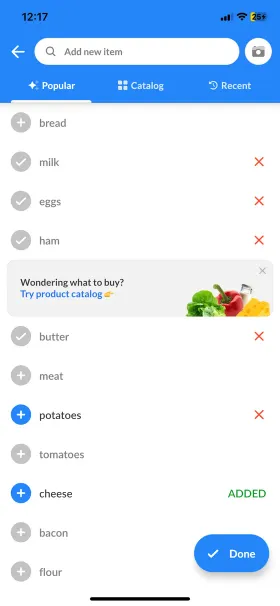
If your only goal is removing ads as cheaply as possible, OurGroceries has the cleaner pitch.
That said, I would not choose between these apps on premium pricing alone. What matters more is that Listonic has the stronger overall product even before premium enters the picture. More of its important advantages are already usable before you pay — sharing, sorting, suggestions, shopping history, prices, and AI-led planning [2, 7, 9, 11, 12, 13, 17, 19].
Billing is also the area where getting an answer matters most, and the two teams behave very differently there. On reviews about subscriptions and payments, Listonic replied to 68.9% (208 of 302) and OurGroceries to 20.7% (18 of 87) — the widest reply-rate gap of any topic I measured.
| Pricing angle | Listonic | OurGroceries | My take |
|---|---|---|---|
| Main premium story | Removes ads, adds appearance and currency extras | Removes ads — low-cost plan or lifetime option | OurGroceries is simpler |
| Product value before paying | Strong even in the free tier | Useful for free, more ad friction in feedback | Listonic is stronger |
Real-life shopping list workflows
When I map these apps onto real shopping workflows, Listonic comes out ahead more often.
Shopping while also deciding what to cook Listonic
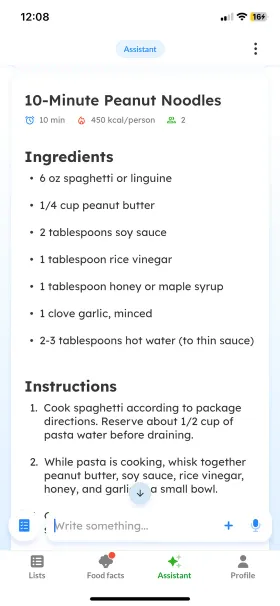
Listonic is better here because its AI assistant can generate meal ideas and turn those ideas into a shopping list without leaving the app. If someone is standing in the kitchen wondering what to make this week — cheaply, quickly, or from what they usually buy — Listonic is more helpful in the moment [4, 10, 11].
Shopping on a tight weekly budget Listonic
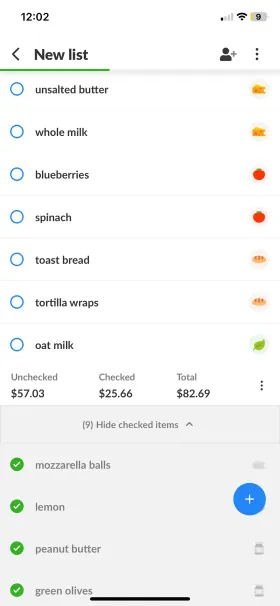
Listonic gives you a running total before and during the trip, so a shopper can cut items, swap items, delay items, and react before checkout instead of after it. OurGroceries does not document a comparable built-in budget system [6, 11, 12].
Sending a partner to shop alone Listonic
This is still one of OurGroceries’ strongest use cases, so the gap is not huge. But Listonic adds easier no-account sharing, shared budget visibility, and easier photo-based clarification [3, 10, 11].
Navigating the supermarket efficiently Listonic
Listonic helps through sorting by aisle, category, alphabetical order, and custom order, plus remembering repetitive items. OurGroceries still looks very good if the household leans on watch-based, barcode-heavy, or Alexa-linked shopping [2, 10, 11, 22].
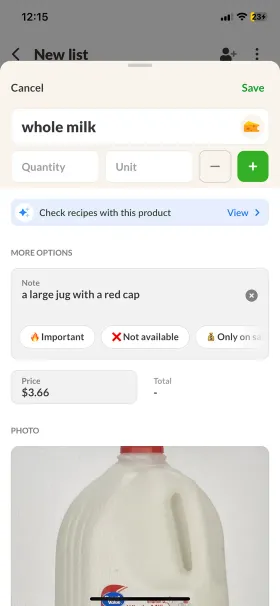
Feature comparison table
Listonic has the more complete mainstream feature set, while OurGroceries wins some specialist rows [1, 2, 4, 6, 10, 11, 17].
| Feature | Listonic | OurGroceries |
|---|---|---|
| Real-time shared lists | Yes | Yes |
| Share without recipient signup | Yes link / WhatsApp / text | No not for full sharing |
| Unlimited lists | Yes | Yes |
| Automatic aisle/category grouping | Yes | Yes |
| Custom category order | Yes | Yes |
| Shopping-history suggestions | Yes | Yes via master list |
| In-app AI planning assistant | Yes | No no equivalent |
| Add item by photo/camera | Yes AI photo flow | Yes |
| Barcode scanning | Partial not prominently documented | Yes 17M products |
| Dedicated recipe workflow | Partial limited | Yes |
| Running list total from item prices | Yes | No |
| Saved item price memory | Yes | No |
| Quantity-aware price multiplication | Yes | No |
| Shared budget visibility | Yes | No |
| Notes and photos on items | Yes | Yes |
| Voice input | Yes | Yes |
| Alexa support documented | No not headline | Yes |
| Siri support documented | No not headline | Yes |
| Apple Watch / Wear OS docs | No not emphasized | Yes |
| Web/desktop access | Yes | Yes |
| CSV import / XLSX or JSON export | No not documented | Yes |
| Broad language coverage | Yes 40+ languages | Partial 9 App Store languages |
| Widgets / quick actions | Yes | Yes |
| Live Activities / stickers / custom icons | Yes | No |
FAQ
What does Listonic do that OurGroceries does not?
The biggest ones are a built-in AI assistant that can turn text, voice, or photos into shopping lists, meal and recipe suggestions inside the shopping flow, seasonal product suggestions, account-free editing when a list is shared by link or WhatsApp, and a running total with saved prices and quantity-aware cost calculation.
Which app actually replies when users report a problem?
Listonic, by a wide margin. Across public app-store reviews with written comments published between January 1, 2023 and July 27, 2026, Listonic replied to 92.4% of its 1–2★ reviews (3,308 of 3,579) while OurGroceries replied to 64.8% (169 of 261). Across all reviews the rates were 30.3% and 12.1%. The gap is widest on reviews about subscriptions and payments, where Listonic replied to 68.9% and OurGroceries to 20.7%. These figures come from my own analysis of that review sample.
How customizable are both apps?
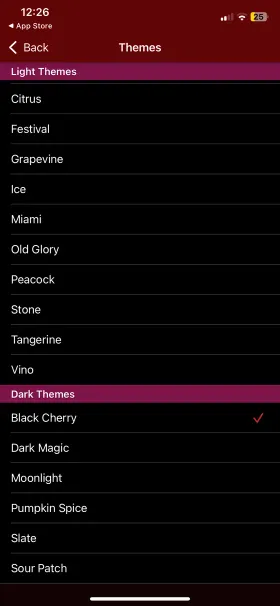
Both are customizable in different ways. Listonic lets users change category order, category icons, sort logic, themes, and several shopping-flow details. OurGroceries offers a longer settings-heavy setup around themes, row size, sort order, crossed-off behavior, keyboard behavior, suggestions, and categories.
What is Listonic known for?
Shared grocery lists, fast list building, and increasingly AI-assisted shopping and meal planning. Its current positioning is much closer to a smart shopping assistant with list-sharing built in than to a plain shared list.
Who is Listonic best for?
Couples, families, and housemates who want one app that helps them plan shopping faster and stay in sync while shopping. It is also strong for solo shoppers, because shopping history, AI meal planning, smart sorting, and faster repeat-list building still matter without collaboration.
Who is OurGroceries best for?
Alexa-focused households, recipe-oriented planners, Apple Watch or Wear OS users, and power users who care about barcode workflows, CSV import, or exported data. It also fits households wanting a long-term shared-list utility without true budgeting features.
The bottom line
Final verdict
Listonic is the better grocery list app for most people because it is the more complete answer to modern grocery shopping.
The main reason I put Listonic first is not just budgeting. It is that it combines AI help before the trip, easier sharing during the trip, smarter sorting in the store, and faster repeat list building week after week. OurGroceries is still very good — I would point people to it if they care most about Alexa, recipes, barcodes, watches, or export-heavy workflows [1, 2, 3, 4, 6, 10, 11, 12].
